The Rail That Refuses to Die: Why Checks Still Matter in Modern Payments
Checks are evolving into a smaller but still essential role in high-value payments. Even as ACH, real-time payments, and stablecoins grow, businesses still rely on checks for complex, trust-heavy transactions.

Every few years, someone declares the check dead. And every few years, businesses write billions more dollars' worth of them.
Yesterday we announced support for physical and digital checks via Modern Treasury's Payment Service Provider (PSP). On the surface, this might seem like a strange place to put our focus. We've talked before about how much momentum real-time rails are picking up, and we've been heads-down building out our stablecoin product. So why spend engineering time on checks in 2026?
Our customers asked us to, and when we actually dug into the data behind that request, it turned out to be a lot more interesting than "checks are still around."
Payment rails don't die
It's true that check usage is in structural decline. Consumers have mostly moved on: the Atlanta Fed found that only 7% of consumers paid a bill by check in 2024, down from 19% just four years earlier. On the business side, a recent Citizens Bank survey found checks fell from 59% of business payments in 2024 to under 50% in 2025.
But the remaining check disbursements tend to be larger, less frequent, and tied to workflows where trust, compliance, or recipient preference matter more than speed.
Value isn't following volume at the same pace. The Fed's own payments studies have shown checks declining much faster by number than by dollar amount, and the reason is simple: the average check has gotten a lot bigger.
As smaller, recurring check use cases (payroll, small refunds, person-to-person payments) get replaced by cards and ACH, what's left behind is a smaller number of larger, infrequent, and higher-trust payments. According to the 2025 Federal Reserve Payments Study, checks are still worth roughly $24.5 trillion a year, which represents a massive opportunity even as the number of checks written has fallen for two decades.
Checks aren’t dead by any means. They’re well represented in high-value, low-frequency, and approval-heavy payments where the counterparty either can't or won't take anything else.
Where businesses still rely on check payments
A few patterns come up constantly once you look at check usage by industry instead of in aggregate:
- Insurance. According to CB Insights, checks make up over half of all insurance company transactions, which is more than double the average across other industries, largely because claims payouts still run through legacy adjudication systems built around paper.
- Real estate. A 2024 PYMNTS Intelligence survey revealed that nearly 21% of all B2B transactions in the industry are done with checks, driven by large one-off transactions like security deposits, repair reimbursements, and closing costs.
- Construction. Progress payments, retainage, and subcontractor payouts are tied to inspections and sign-offs, and a meaningful share of subcontractors aren't set up to take anything but a check.
- Government, healthcare, and legal. Disbursements, settlements, and vendor payments where a paper trail is a compliance requirement still need checks.
That combination of a rail that's high-value, hard to replace, and “outdated” is exactly the kind of problem we think belongs inside a payment infrastructure platform, with the same orchestration, reconciliation, and controls we'd apply to any other rail, instead of being bolted on separately.
Pairing checks with the newest rails
We're in the midst of an exciting time to be in payments. New rails like stablecoins open up dollar-denominated use cases that just weren't possible a few years ago, and we're going to keep investing there.
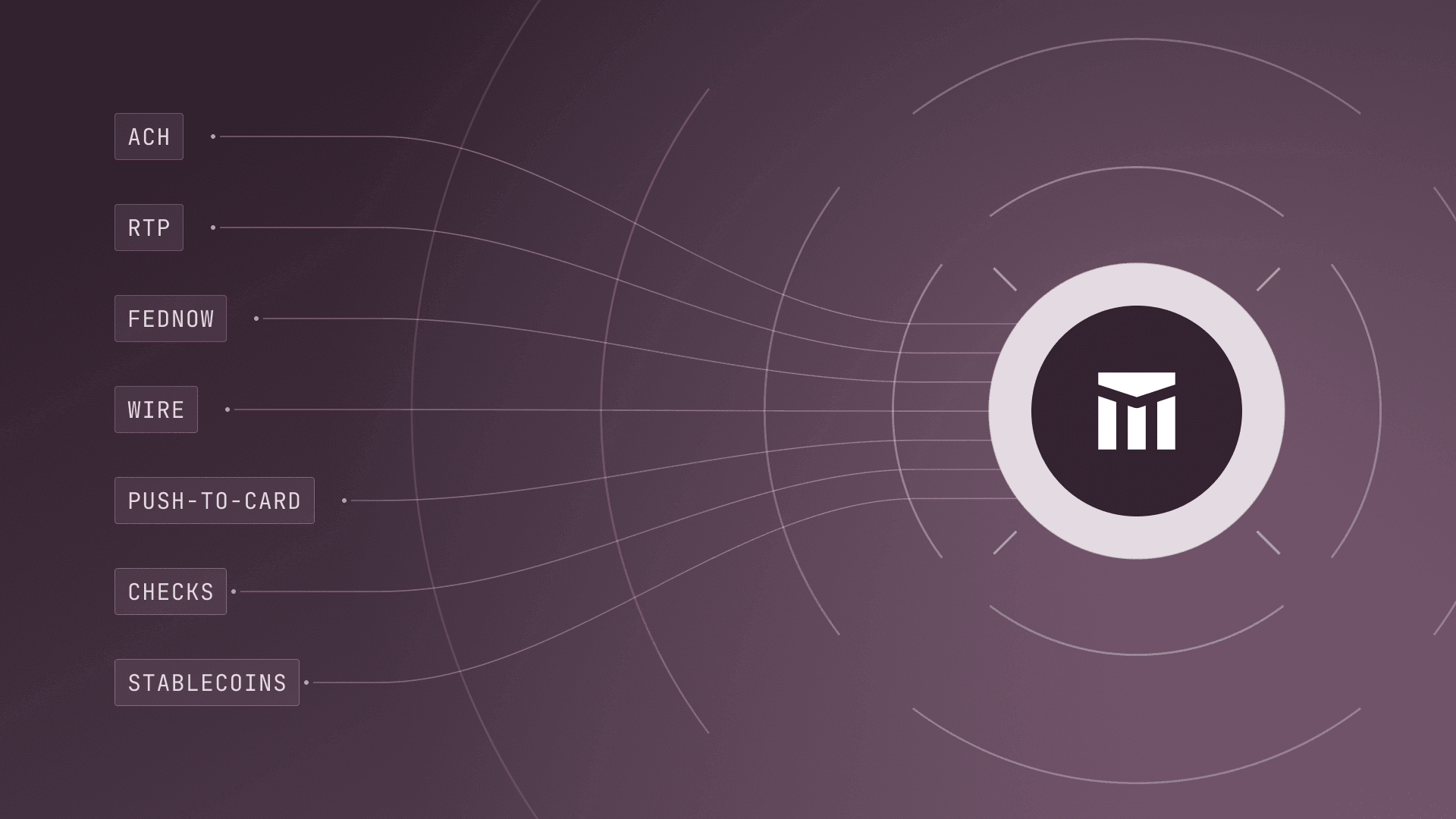
We're building checks alongside stablecoins, RTP, FedNow, ACH, and wire transfers because modern payment infrastructure is about giving businesses the flexibility to route payments over the rail that best fits each transaction.
Whether you need an instant payout with the widest possible reach, or you need to cut a physical check because that's the only thing your counterparty will accept, it should all run through one API.
If you want to learn more about our PSP that supports checks alongside ACH, wire, RTP, FedNow, push-to-card, and stablecoins, visit moderntreasury.com/products/payments.
Get the latest articles, guides, and insights delivered to your inbox.
Authors

Matt Craig is the Product Manager for Payments at Modern Treasury, responsible for architecting the company’s multi-rail platform that unifies bank rails and stablecoins into a single, developer-friendly system. Before joining MT, he built Payflows’ global treasury management platform with integrations to 50+ banks and held product and operations roles at Qonto and Back Market overseeing high-volume payouts and risk systems.