Why the Ledger Is the Foundation of Any Modern PSP
The ledger is the foundational layer that any modern PSP must be built on. Without it, the entire system operates on fragmented data. Most legacy PSPs treat the ledger as an afterthought or leave it to customers to build internally. Modern Treasury took the opposite approach: a proprietary ledger, purpose-built for payments and battle-tested across hundreds of billions in payment volume, is the foundation the entire platform is built on.

Ask any payments team what their biggest operational pain is and you'll hear some version of the same answer: "We can't get a clean picture of what happened to our money."
There is drift between internal and external reporting. Exception handling bounces between teams. Finance can't close books with confidence. These aren't separate problems. They're symptoms of the same architectural gap. Most payment infrastructure needs to sit on top of a unified ledger. Without one, everything else is built on sand.
Why is the ledger the foundation of a PSP, not a feature?
There's a common misconception that a PSP's primary job is to move money. Execute the payment. Connect to the rail. Return a status.
Execution matters. But execution without a ledger is just plumbing. It moves money without being able to explain where the money went, why it went there, or what state it's in right now.
Every other capability a PSP needs to provide depends on having a reliable, real-time understanding of the financial state.
Multi-rail orchestration requires knowing which account to fund from, whether the balance is sufficient, and how to represent the payment's lifecycle regardless of where it is in a funds flow. That's a ledger problem.
Upstream controls require pre-execution checks against accurate balances and limits. Fraud screening, compliance gates, funding validation: all of them need a source of truth to check against. That's a ledger problem.
Reconciliation requires matching external events (transactions, balances, payment statuses) against an internal record that tracks every state transition. That's a ledger problem.
Auditability requires a complete, timestamped record of every decision, approval, state change, and exception. That's a ledger problem.
Strip the ledger out, and a PSP is just an API that sends payment instructions to banks. The intelligence, the control, the operational confidence: all of it comes from the ledger.
Why don't legacy PSPs have a real ledger?
Legacy PSPs were built execution-first. Stripe, Adyen, and others started by solving a specific problem: connect merchants to card networks and process transactions. Their internal data models track the lifecycle of a payment within their own environment. They were never designed to serve as a system of record across all providers, rails, and internal systems a company operates.
That made sense in a simpler era. When payments were card-based, single-rail, and linear, the PSP's internal state was close enough to the full picture. You didn't need a separate ledger because the PSP's view and reality were roughly the same.
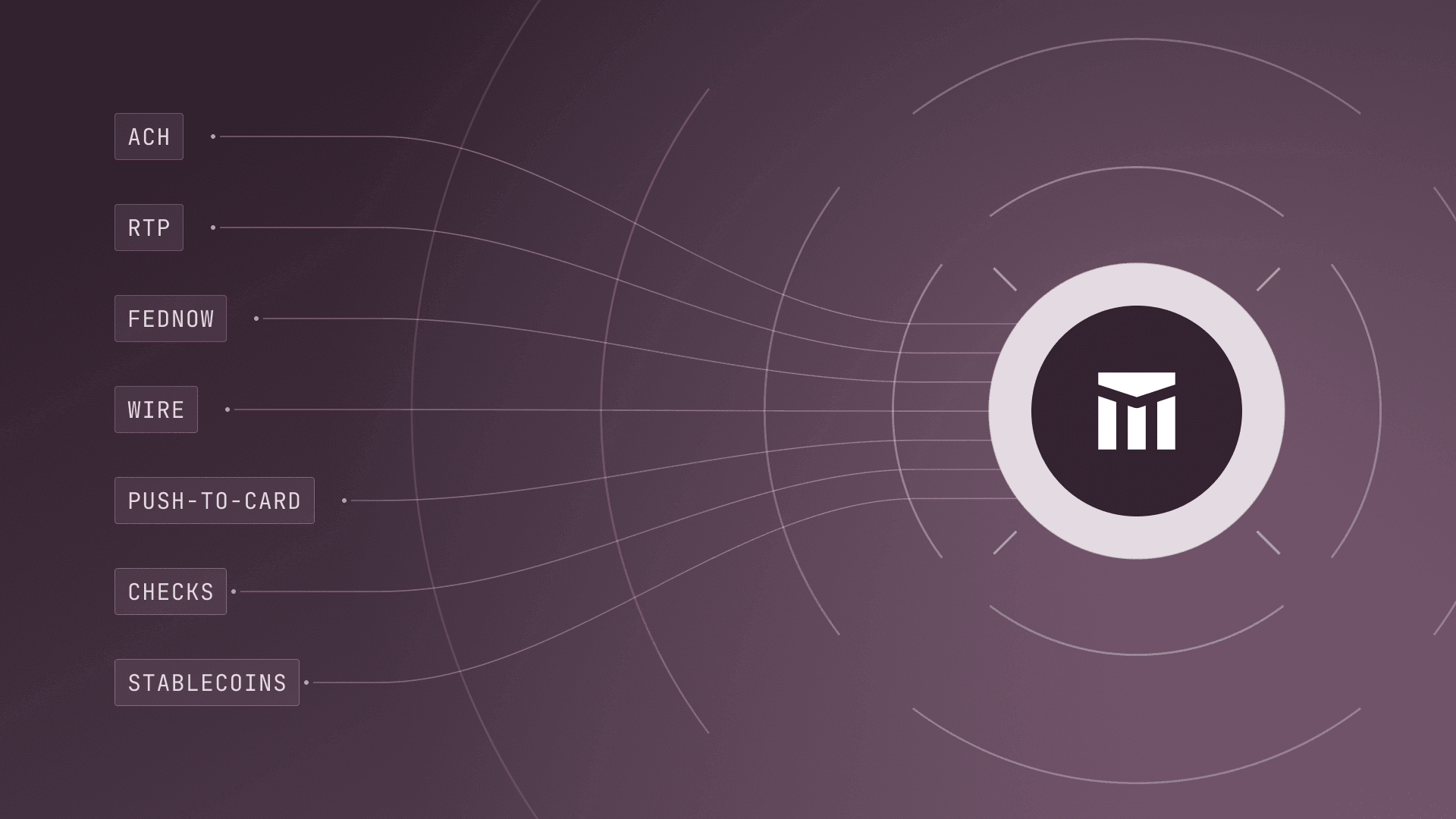
Multi-rail changed that. When a single company operates across cards, ACH, wires, RTP, FedNow, and stablecoins, through multiple banking partners and providers, the PSP's internal state is just one view among many. Your bank has a different view. Each rail has a different view. Your internal systems have yet another view.
The result is state fragmentation: the same payment exists in multiple states across multiple systems simultaneously. Your PSP says "completed." Your bank says "pending." The ACH network says "returned." Same payment. Multiple truths.
Most companies try to solve this by building internal reconciliation systems: databases, scripts, and spreadsheets that pull data from every provider and attempt to stitch together a unified picture after the fact. These systems are expensive to build, expensive to maintain, and brittle at scale. They are workarounds for a missing foundation.
The right answer isn't a better reconciliation script. It's a ledger that serves as the source of truth from the moment a payment is initiated.
What does state fragmentation actually cost?
The cost is concrete and measurable.
Reconciliation scales linearly with payment volume. Without a unified ledger, every new payment, every new rail, and every new provider adds reconciliation work. Finance teams match internal records against bank activity, settlement reports, processor data, and rail confirmations manually. The work grows with volume, and it never gets easier.
Exception handling has no clear owner. A payout fails. The failure could originate from the destination account, the funding account, a compliance hold, or a rail-specific cutoff. Those signals come from different providers at different times. Without a single system tracking the full lifecycle, exceptions bounce between teams until someone pieces together what happened.
Close timelines slip. When the ledger doesn't match the bank statement, and the bank statement doesn't match the PSP report, finance can't close with confidence. Auditors ask questions nobody can answer quickly.
Audit trails are scattered. Approvals, holds, releases, and reconciliation actions happen across teams and systems. The record of who did what, when, and why is fragmented across 10 systems instead of centralized in one.
Every one of these costs traces back to the same root cause: no ledger at the foundation.
How did Modern Treasury build its ledger?
We took the opposite approach from legacy PSPs. We built the ledger first. Everything else (multi-rail execution, upstream control, reconciliation, compliance) was built on top of it.
Modern Treasury's ledger is proprietary, purpose-built for payments, and has backed more than hundreds of billions in payment volume. It wasn't adapted from an accounting system or bolted onto an execution engine. It was designed from the ground up as the foundation for a modern PSP.
Here's what that means in practice:
- Double-entry accounting across all providers and rails. Every payment, regardless of rail (ACH, wire, RTP, FedNow, stablecoin), is ledgered from initiation through settlement with full double-entry bookkeeping. Credits and debits balance. Net liabilities are tracked. State transitions affect the ledger in real-time. The ledger is always consistent.
- A unified state model across different rails. Each rail has its own native behavior: ACH is batched and wires are irreversible, RTP is instant and 24/7, stablecoins settle with cryptographic finality. The ledger maps every rail's events to a consistent state model so that operations teams work with one set of statuses, not five.
- Real-time balances across all connected accounts. The ledger maintains a live, accurate view of balances across every bank account, provider, and rail. Funding decisions are made against the current state, not a snapshot that ran five minutes ago.
- Continuous reconciliation. External events from banks, rails, and providers are matched against the ledger automatically and continuously. Discrepancies surface immediately with full context rather than during monthly close.
- Complete auditability by default. Every action (approval, hold, release, state transition, reconciliation match) is recorded in the ledger with timestamps, attribution, and context. The audit trail isn't assembled after the fact. It's a byproduct of the ledger doing its job.
What does a ledger-first PSP change for operations teams?
When the ledger is the foundation, payment operations can scale.
"What happened to this payment?" is answered in seconds from one system. Not five systems, not a spreadsheet investigation, not an escalation chain. One query. One answer. Complete confidence.
Reconciliation shifts from reconstruction to verification. The ledger is the source of truth from initiation. External events reconcile against it, not the other way around. Discrepancies are caught in real time, not discovered weeks later.
Exception handling gets clear ownership. Every payment's full history, which rail, what state, what failed, why, lives in one system. The team investigating an exception has the complete picture without querying multiple providers.
Funding decisions are accurate. The ledger's real-time balance view means "do we have the funds?" is answered against the current state across all accounts. No stale data. No race conditions between balance checks and payment execution.
Finance closes books with confidence. The ledger and the bank statements agree because reconciliation is continuous, not periodic. Auditors get clean answers because the audit trail is complete by default.
Hundreds of billions in payment volume has run through this ledger. That's not a proof of concept. It's production infrastructure that companies trust to be the single source of truth for how their money moves.
Read the full architectural evolution of PSPs in our Practical Guide to PSPs in 2026.
Frequently asked questions
Why is the ledger the foundation of a PSP and not just a feature?
Every core PSP capability (multi-rail orchestration, upstream controls, reconciliation, compliance, auditability) depends on having a reliable, real-time understanding of the state of money movement. Without a ledger at the foundation, these capabilities operate on fragmented data from multiple providers. The ledger is what makes a PSP a system of record, not just a payment execution engine.
What is state fragmentation in payments?
State fragmentation occurs when the same payment appears in different states across different systems simultaneously. For example, your PSP may show a payment as "completed" while your bank shows it as "pending" and your internal ledger shows it as "settled." This happens because each provider tracks its own lifecycle independently, with different timing and different status definitions. A unified ledger eliminates state fragmentation by serving as the single source of truth from initiation through settlement.
Can you build a unified ledger on top of an existing PSP?
Companies often try. They build internal reconciliation databases, status mapping tables, and custom scripts to normalize data from their PSP, bank, and other providers. These systems become expensive to maintain and brittle at scale because they're working around the PSP's native state model rather than replacing it. A purpose-built ledger designed as the system of record from day one is more reliable and significantly less costly to operate at scale.
Get the latest articles, guides, and insights delivered to your inbox.
Authors

Matt Craig is the Product Manager for Payments at Modern Treasury, responsible for architecting the company’s multi-rail platform that unifies bank rails and stablecoins into a single, developer-friendly system. Before joining MT, he built Payflows’ global treasury management platform with integrations to 50+ banks and held product and operations roles at Qonto and Back Market overseeing high-volume payouts and risk systems.