Live Webinar on Dec 3rd: How They Built It: Albert, GrowIt, and NFTYDoor share the payment decisions they’d make again. Register now →
Why sub-account reconciliation breaks at 100 accounts, and how to design it so it doesn't
As customer accounts grow, missing payments details can turn sub-account reconciliation into a full-time job. Virtual account numbers, expected payments, and clear exception workflows help keep balances accurate as you scale.

When I first started working on a money-moving product, a real estate investment program, we were able to reconcile a handful of customer sub-accounts in a spreadsheet. At a small scale, that’s manageable. Someone exported the bank statement, matched each line to a customer and checked that the totals agreed. At 100 sub-accounts, the same process was heading towards taking up a full-time role. At 1,000, it usually means the books close late and the sponsor bank starts asking questions about balances. So we had to automate it.
It's easy to blame volume for this. In practice, the trouble starts with individual payments that can't be traced to a customer when they arrive. Each one has to be investigated by hand, and as volume grows, so does the number of those “edge case” payments.
Broken or missing sub-account reconciliation is the problem platforms raise with us often. Most of its causes can be addressed in how the system is designed, before volume makes them expensive.
Where Sub-Account Reconciliation Breaks
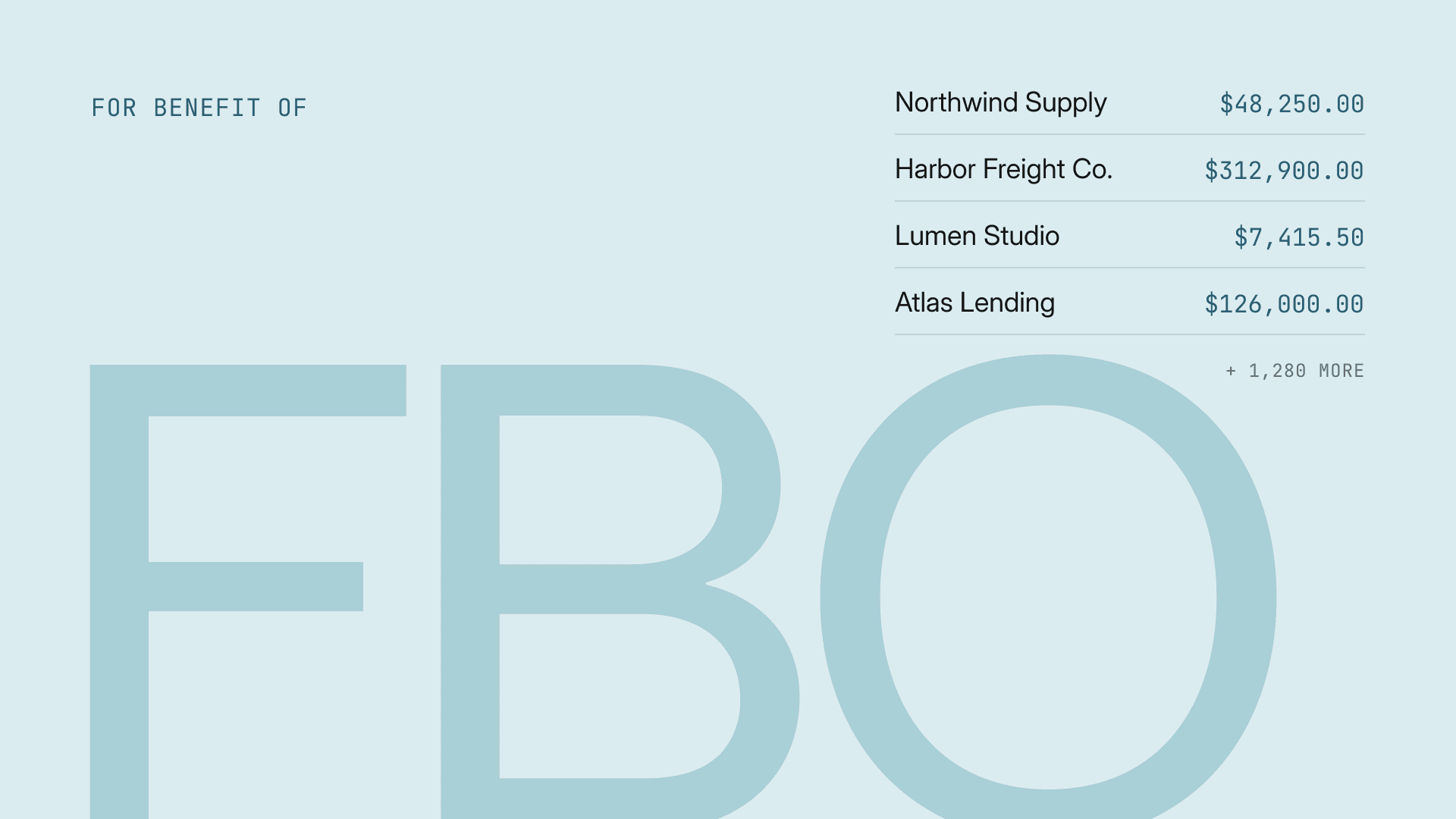
Reconciliation is the process of confirming that your records match what actually happened at the bank. At the account level, that means checking that the sum of all customer balances equals the balance in your FBO account. Sub-account reconciliation goes one level deeper. It checks that each customer's balance reflects the payments that customer actually sent and received.
We see sub-account reconciliation break in four places.
Inbound payments without a clear owner. Say a $40,000 wire arrives in your FBO account with "INV 2231" in the memo field. If every customer shares the same account number, someone has to read the memo, search your system for that invoice and decide which customer to credit. That's a few minutes of work for one wire, and a backlog when it happens dozens of times a day.
Batched settlements. Card processors and other payment providers often settle in a single deposit that covers many transactions, with their fees already deducted. The bank statement shows one credit, but your ledger needs one entry per customer. The processor's remittance report has that breakdown. The bank line doesn't.
Returns after funds are spent. Suppose you credit a customer for an ACH debit and they withdraw the money the same day. If the debit is returned two days later, for example, with R01 (insufficient funds), their balance goes negative. Unauthorized consumer debits can be returned for up to 60 days. To explain the negative balance, the return needs to be linked to the original payment.
Fees deducted from the account. Bank fees, processor fees and your own platform fees reduce the FBO balance without a matching customer transaction. If they aren't recorded in the ledger at the same time, the ledger and the bank drift apart by small amounts each day.
Each of these comes down to information that's missing when a payment is recorded. The rest of this post covers how to capture it up front.
Reconciling Against Expected Payments
We often see teams reconcile after the fact: they start with the bank statement and work out what each line was. That works with a small number of transactions, but it depends on someone remembering the context behind each payment, and gets more difficult as payments get cut or combined into new sums and dates.
A more reliable approach is to record what you expect before the money moves. An expected payment is a record of a payment you know is coming, with enough detail to match it automatically:
- The direction and amount, or an amount range if the final figure can vary.
- A date window that accounts for settlement timing and bank holidays.
- The counterparty, and the customer whose sub-account the payment belongs to.
- Any reference you control, such as an invoice ID or a payment ID.
When the bank reports a new transaction, it's compared against open expected payments rather than against everything in your system. For developers, it's similar to writing a test assertion before running the code: you define the expected result, then check the actual result against it.
Outbound payments are straightforward, because your system created them and already has the details. Most of the benefit is on inbound payments. Examples include a wire a customer has told you about, a loan repayment scheduled for the 15th, or a processor settlement due two business days after the sales it covers.
With expected payments in place, exceptions fall into two categories: expected payments that didn't arrive, and payments that arrived without a matching expectation. Both need review, and there are far fewer of them than there would be unexplained bank lines.
Designing for Attribution
Attribution means identifying which customer a payment belongs to when it arrives. Three design choices handle most of it.
Virtual account numbers. A virtual account number is a unique routing and account number assigned to a single customer that routes funds into your shared FBO account. An ACH credit or wire sent to that number is attributed to that customer automatically, regardless of what's written in the memo.
References you control. For payments you originate, include a payment ID in the ACH addenda or wire reference that maps to one record in your system. For invoices, ask payers to include an invoice ID that you generated.
Verified counterparties. If you store verified bank account details for the businesses and individuals your customers transact with, a payment from a known account can be narrowed to a small set of customers, even without a virtual account number.
Batched settlements are handled differently, because the bank line doesn't contain per-customer detail. Import the processor's settlement report, record one ledger entry per customer, and then match the bank deposit against the expected total. By the time the deposit arrives, each customer's share is already recorded.
Exceptions Are a Queue, Not a Mystery
Even a well-designed system has exceptions. The goal isn't zero; it's that every exception is contained, visible and resolved quickly.
We often see teams credit their best guess to a customer and plan to fix it later. That's risky, because a wrong guess spreads into payouts and statements before anyone notices. A better habit is to park anything unidentified in a suspense account. The totals stay balanced, and it's obvious that something is still open.
The same discipline applies everywhere else. Decide your tolerance rules for partial and split payments in advance, such as a $9,950 payment against a $10,000 invoice, or three invoices settled in one wire. Then record why each match was made. Link every return to the specific payment it reverses, not just to the customer, so a negative balance is explainable and its recovery trackable. And give the exception queue an owner and a service-level agreement. A suspense balance that grows week over week is an early warning, not a rounding error.
Two numbers tell you most of what you need to know: the share of bank transactions matched automatically, and the age of the oldest open exception.
This discipline pays off a second time with your bank. Your sponsor bank holds the FBO account, but it relies on your records to know whose money is in it. It will ask you to show your work. A daily attestation that the ledger ties to the bank, an immutable history in which corrections are new entries rather than edits, and per-customer statements you can produce in minutes turn that conversation from stressful into routine.
What One Good Day Looks Like
To make this concrete, here's an illustrative day for a platform with 200 customers, each with their own virtual account number on a single FBO account. The day opens with $4,812,300.00 in the bank: $4,790,050.00 across customer ledger accounts, plus $22,250.00 in earned platform fees that haven't been swept yet.
The totals tie, and it would be tempting to call it a day. But $40,000 is sitting in suspense, and it belongs to someone. A balanced total tells you nothing was lost. Only clearing suspense tells you everything went to the right place. It's also worth checking whether those two returns pushed anyone below zero. And notice that the card settlement only matched cleanly because its remittance detail was in hand before the bank line arrived.
Now picture the same day at 2,000 customers. The automatic matches grow with volume; the work doesn't. The work is the exceptions, and good attribution keeps that number small.
The Short Version
Reconciliation doesn't fail because you got bigger. It fails because some payments arrive without enough information to say whose they are. Give every customer an address, write down what you expect before it happens, and treat the leftovers as a queue with an owner. Do that, and your reconciliation scales with your customer count instead of your headcount.
Modern Treasury helps platforms reconcile every sub-account automatically. Virtual Accounts give each customer a dedicated account number. Expected Payments record what should happen and wait for the match. Reconciliation pairs bank transactions with payments and surfaces the exceptions. Ledgers keep an immutable, double-entry record of every balance.
Read the Expected Payments docs here.
Get the latest articles, guides, and insights delivered to your inbox.
Authors

Dimitri Dadiomov is the co-founder and President of Modern Treasury. Dimitri started his career in product and business development at Better Place and then moved to venture capital before earning his MBA at Harvard Business School. Dimitri is a graduate of Stanford University and spends his free time skiing, hiking, writing, and devouring books.