Platform Fit
Where Modern Treasury Fits
Modern Treasury vs. Other Payment Platforms
Marketplace Payments
Modern Treasury vs. Stripe Connect
Multiple payment rails, but optimized for card-first marketplace flows.
Embedded Banking
Modern Treasury vs. Stripe Treasury
Bank accounts and money movement embedded in the Stripe ecosystem, on Stripe's banking relationships.
Banking as a Service
Modern Treasury vs. Unit
Banking-as-a-service that issues accounts and cards to your end users, rather than moving money over your own bank relationships.
Banking API
Modern Treasury vs. Increase
A single chartered bank delivered as an API, with every rail running through that one institution.
Embedded Payments
Modern Treasury vs. Moov
Card acquiring, wallets, and payouts in one integration, running on Moov's own partner banks.
Card Acquiring
Modern Treasury vs. Adyen
A global card-acquiring and unified-commerce processor, built for enterprise card acceptance at scale.
Cross-Border and FX
Modern Treasury vs. Airwallex
Global multi-currency accounts and FX, with cross-border movement as the primary use case.
Stablecoin Infrastructure
Modern Treasury vs. Bridge
Stablecoin orchestration, issuance, and on/off-ramps, with global payouts as the primary use case.
Stablecoin Payments
Modern Treasury vs. BVNK
Enterprise stablecoin payins, payouts, and fiat on/off-ramps, settled under BVNK's own licenses.
Bank Connectivity
Modern Treasury vs. Plaid
Bank-account connectivity, verification, and data access, often used alongside a payments provider rather than instead of one.
Don't see the platform you're looking at?
Tell us who else is on your list. We'll go through the differences with you, including the cases where another platform is the better choice.
How to Evaluate Payment Infrastructure
Build vs. Buy
Build vs. Buy Payment Infrastructure
Building in house takes 6–18 months and 4–8 engineers. A managed PSP handles bank connectivity, ledgering, and compliance through one API.
PSP Models
What Is an Integrated PSP?
An integrated PSP owns bank relationships, compliance, ledgering, and reconciliation, not just transaction routing.
Embedded ACH
Embedded ACH for B2B Platforms
Standard ACH built for a single business breaks down when every user needs their own payment flows.
Cross-Border
The Stablecoin Sandwich vs. Traditional Cross-Border
How the stablecoin sandwich model measures against correspondent banking on settlement speed, FX cost, and reconciliation.
Payments Processed
Across Fiat and Stablecoins
Not Months to Go Live
Before You Decide
Why Modern Treasury
Pricing
Platform Overview
Common Questions About Evaluating Payment Platforms
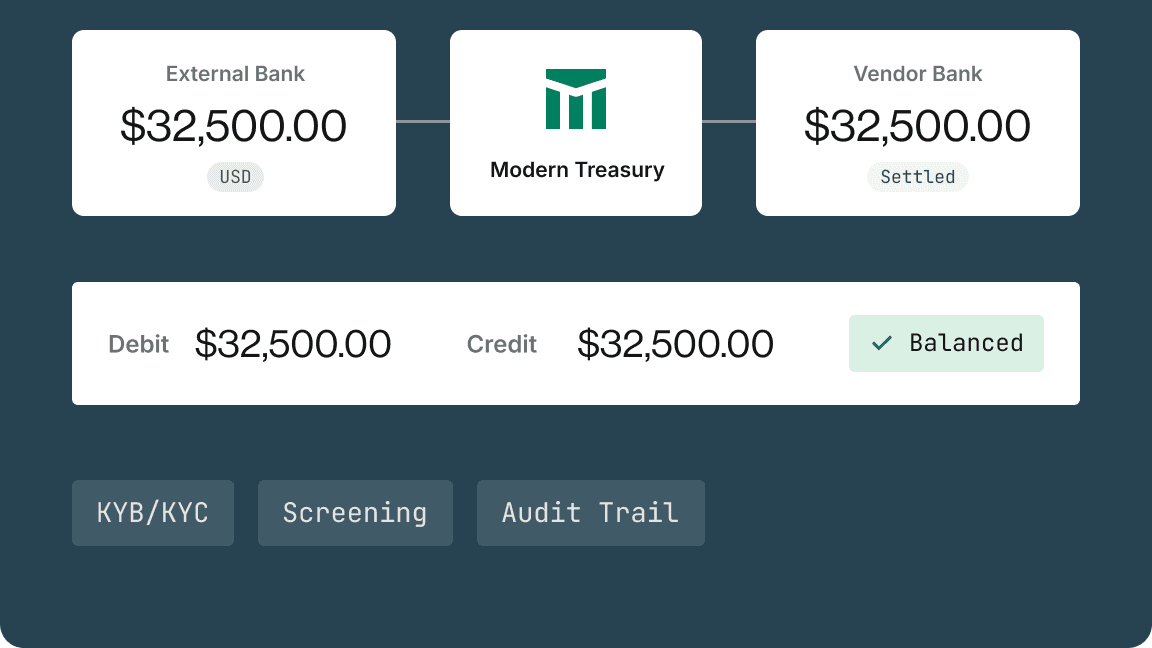
It depends on what you're moving. Stripe Connect and Adyen are card-first processors. Unit and Stripe Treasury are banking-as-a-service providers that issue accounts to your end users. Increase is a single chartered bank behind an API. Airwallex is built for cross-border and FX. Modern Treasury is a payment service provider for platforms moving money over bank rails: ACH, RTP, FedNow, wire, push-to-card, checks, and stablecoins, with a real-time ledger underneath.
Stripe has two products that platforms weigh against Modern Treasury. Stripe Connect splits card revenue between a platform and its sellers. Stripe Treasury embeds bank accounts inside the Stripe ecosystem. Both are built around Stripe's own banking relationships. Modern Treasury runs on bank rails directly, and you can use our bank partners or bring your own.
Five things decide most evaluations: which rails the provider supports natively rather than through an abstraction, whether the ledger is real-time and auditable, where the compliance boundary sits between the provider, its partner banks, and your team, whether you can bring your own bank, and what the pricing does as volume grows.
Building bank connectivity, a ledger, and a compliance program in house takes most teams 6–18 months and 4–8 engineers, and the maintenance cost never ends. Buying makes sense when payment operations are not the product. Building makes sense when the payment flow itself is the differentiator and no provider models it.
Neither. Modern Treasury is an integrated payment service provider. It owns the bank relationships, the compliance program, the ledger, and reconciliation. An orchestration layer routes transactions to other providers and leaves those responsibilities with you.